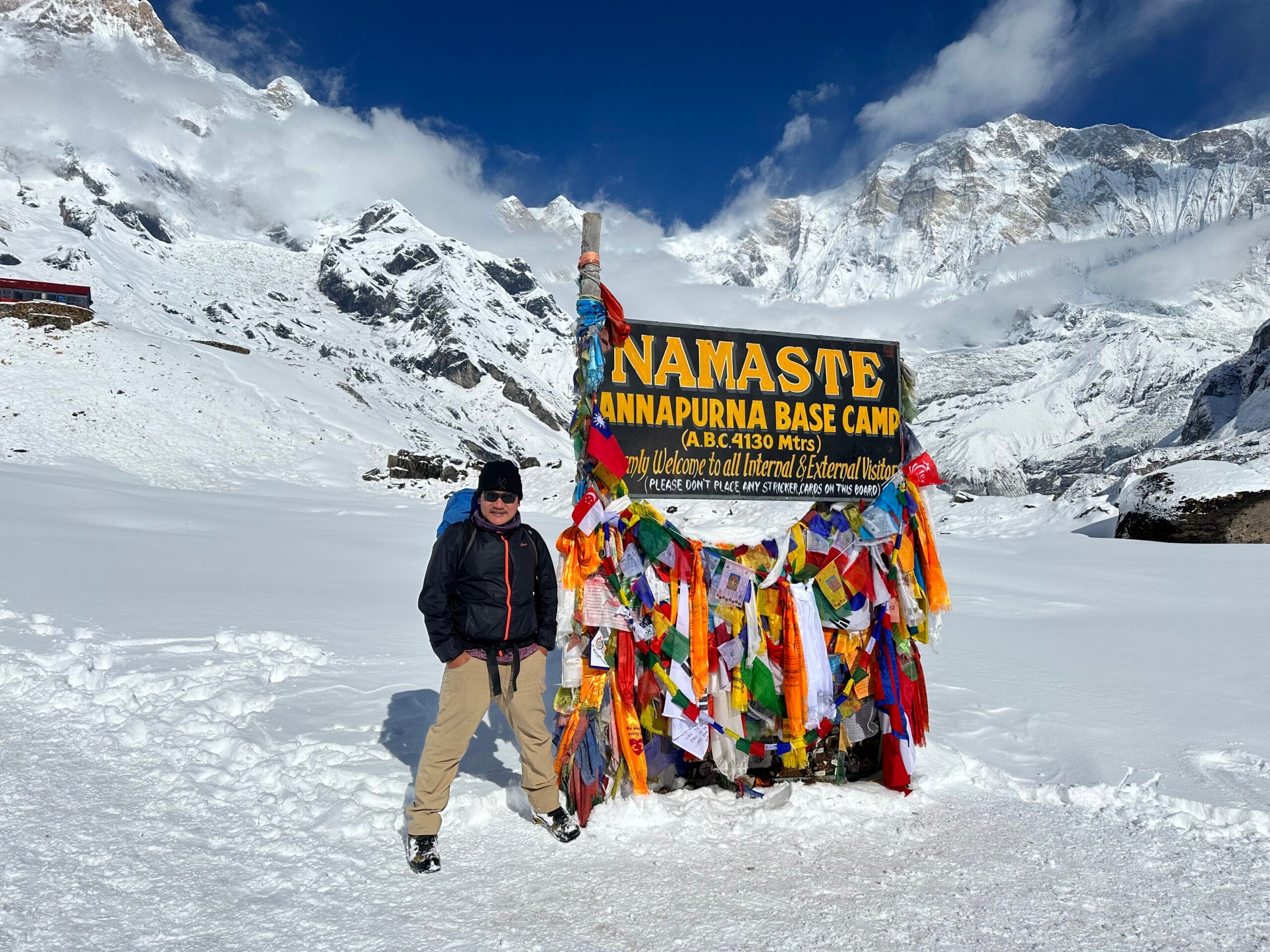
Breathtaking Mountain Vistas: Experience up-close, 360-degree panoramic views of towering Himalayan peaks, including Annapurna I (the 10th highest mountain in the world at 8,091m), Annapurna South, Hiunchuli, and Gangapurna.
Two Base Camps in One Trek: The trail allows you to visit two iconic base camps: Machhapuchhare Base Camp (3,700m), offering incredible views of the unique "Fishtail" mountain, and your ultimate destination, Annapurna Base Camp (4,130m).
Annapurna Conservation Area: Walk through a protected, biodiverse sanctuary filled with oak, bamboo, and vibrant rhododendron forests (which bloom spectacularly in the spring). You may even spot local wildlife like the Himalayan tahr, musk deer, and the colorful Himalayan Monal.
Cultural Immersion: The route passes through traditional Gurung and Magar mountain villages like Ghandruk and Chhomrong. This provides a great opportunity to experience authentic Nepali hospitality, stay in local teahouses, and observe rural Himalayan lifestyles.
Jhinu Danda Hot Springs: On your descent, you can take a relaxing and rejuvenating dip in the natural hot springs at Jhinu Danda, located right along the Modi Khola river.
Stunning Sunrises: Watching the sunrise illuminate the snow-capped peaks of the Annapurna massif and Machhapuchhare with a golden alpenglow is often described as one of the most unforgettable moments of the trek.
Diverse Terrain: The trek offers a constantly changing landscape, starting from subtropical forests and terraced farmlands at lower elevations, all the way up to rugged, high-altitude alpine terrain and glacial valleys.
Hello travelers from across the globe! We are delighted to provide you the trekking itinerary which is the shortest option to reach the Annapurna Base Camp. The travel planners of the Hikers Himalaya have knitted the best package which is flexible in rates and shorter in days.
In about 5 Days, you can complete the Annapurna Base Camp Trek from Pokhara. The best thing about the trek is that you have the option to travel on your own around Kathmandu and Pokhara before starting the trek.
The trekking crew members of the Hikers Himalaya will meet you in Pokhara and begin the trek. All the trip management issues will be handled by the company and you will simply have to show up in Pokhara!
Honestly, it boils down to time and payoff. Why spend ten days just walking to a base camp when you can practically skip the boring parts? Starting from Pokhara cuts the fluff. You hit the good stuff fast.
One minute you’re dodging scooters in Lakeside, and a few hours later, bamboo forests swallow you whole.
It’s the ultimate fast-track to high-altitude glory, giving you those massive icy peaks right in your face without the endless preliminary slog. Plus, there’s hot springs. Who doesn’t want to soak aching calves in naturally boiling water after dragging themselves up a thousand stone steps?
Please check our regular Annapurna Base Camp Trek 12 Days package that takes you to the same base camp but with a longer itinerary. There is another way as well via Poon Hill section.
Therefore, the number of days required to do the Annapurna Base Camp Trek in Nepal depends largely upon the type of itinerary that you have agreed during the time of package finalization.
As for the Annapurna Base Camp Trek from Pokhara, you can complete this joyous yet adventurous journey to the foothill of the world’s 10th tallest mountain, Mount Annapurna (8091 m) in just 5 days.
Note that the trek itinerary starts from Pokhara and ends in Pokhara.
The trekking distance of the regular Annapurna Base Camp Trek via Poon Hill is about 65 to 77 kilometers.
However, the shorter route of the ABC Trek in Nepal is around 50 kilometers to 56 kilometers. It is the trekking distance and it is also the route of the trekking that starts from Jhinu New Bridge and ends in the same place retracing the same trail.
Just a couple of marathons over five days! But distance up here doesn’t mean anything. It’s all about the up and down.
You’ll cover maybe ten kilometers in a day and feel like you ran through wet cement while carrying a fridge. Flat sections simply do not exist out here. Every single step demands payment from your knees.
Getting to the trailhead is an adventure in itself. You jump into a local jeep in Pokhara, squished between backpacks and probably someone’s rogue chicken.
It takes about an hour and a half to reach the suspension bridge near Jhinu Danda. The road? It’s more of a suggestion. Expect potholes that could swallow a small dog and hairpin turns that make you grip the door handle until your knuckles turn white.
Honestly, surviving the drive makes the actual walking feel pretty safe.
Once you tumble out at the river, dust off your knees, you’re officially on the clock. Nowadays, the road condition is better compared to a few years ago.
More than half of the road has already been asphalted but still some sections are damaged by landslides.
The difficulty level of the Annapurna Base Camp Trek from Pokhara is challenging. Understand one fact beyond fluffy articles that you see on the internet: the trail requires immense cardiovascular abilities.
Endless staircase trail made of stone can be scary. Your knees can be burnt out while trekking uphill and downhill in this staircase trail, especially the section near Chhomrong and Sinwua – Deurali!
Overall, the difficulty level of the Annapurna Base Camp Trek from Pokhara is moderately difficult.
Besides the trail’s uphill and downhill sections, the altitude can play a major role in increasing the difficulty level.
The trail is not as hard as the Everest Base Camp Trek due to altitude but still poses a serious threat.
The maximum altitude a trekker reaches during the trek is 4130 m above sea level. This is also the highest altitude a trekker stays overnight.
Therefore, it is important to note the impact of altitude, especially for two nights: one in Deurali Village (3230 m) and another in Annapurna Base Camp (4130 m).
Ideal time to do the trek is highly necessary after investing thousands for the trek. If you can’t get the best scenery of mountains and landscape without any interruption, then it is not fruitful to do the trek.
While trekking, if you experience heavy rainfall and heavy snowfall, then there’s no point in doing the trek!
Therefore, it is important to select the best time for Annapurna Base Camp Trek from Pokhara. Spring season (March – May) and autumn season (September – November) are ideal times to do the ABC Trek from Pokhara.
Clear skies, warm weather, and vibrant atmosphere make these months of spring and autumn season ideal for trekking.
You start relatively low, around 1,500 meters at the drop-off. By the time you hit Base Camp, you are standing at 4,130 meters.
That is a massive jump for a short timeframe. Your body is going to notice. The air gets thin, cold, and dry, stripping the moisture right out of your throat.
Elevation gain isn’t a smooth curve, either. You’ll climb 800 meters, drop 400 into a river valley, and climb another 500 just to sleep.
It’s a rollercoaster that punishes your thighs and begs your lungs to adapt faster than they legally should.
The scenery flips like a frantic slideshow. Down low, it’s all terraced fields glowing absurdly green, dotted with stone-roofed Gurung houses.
Dogs bark, kids chase you asking for chocolate, and the air smells like woodsmoke and damp earth.
Higher up? The trees just quit. You enter this desolate, frozen rock garden where nothing grows but hardy scrub.
Bamboo forests give way to alpine meadows. The gorge narrows so much sunlight barely reaches the bottom, making it feel like walking through a freezer.
Every day you wake up in a completely different world than where you went to sleep.
They sneak up on you. You’ll be staring at your boots, hating life, and suddenly the trees part to reveal Machapuchare towering so close you feel like you could touch the snow.
It’s jarring. Once you pass Deurali, the valley opens into the sanctuary, and boom. You are boxed in by giants.
Annapurna I, South, Hiunchuli, Gangapurna. They form this terrifyingly beautiful 360-degree wall of rock and glacier.
Sunrise up there? It sets the icy peaks on fire, glowing this crazy neon orange before the light floods down into the bowl. Best coffee view ever.
The ever-present sight of Machhapuchhre is so amazing while on this trek. The feeling of staying surrounded by snow-capped mountains, starting from Himchuli to Machhapuchhre with the Annapurna series, can surely make our trekking journey full of Himalayan wilderness experiences.
It is truly a blissful trail to trek for amazing mountain vistas.
The Annapurna Base Camp Trek route is the commercial trail of Nepal. Therefore, there are tea houses and lodges along the way. You don’t need to worry about lodging on the trekking route.
Standard basic rooms with warm beds and common bathrooms are present in these tea houses. Common dining halls with heated ovens in the middle are common in almost all tea houses.
As for menu items, expect Nepalese dishes, Korean dishes, Chinese, Oriental, and Indian dishes. Almost all tea houses offer similar menu items.
Please note that the trail has numerous tea houses and eateries at least until you reach Himalaya Village. Beyond this place, there are a limited number of tea houses and eateries.
In fact, places like Machhapuchhre Base Camp and Annapurna Base Camp have few tea houses.
During peak trekking season, you may not find proper rooms to stay overnight if you are traveling alone.
The trekking crew members of the Hikers Himalaya ensure that you get your room at least on a twin-sharing basis, even in places like Machhapuchhre Base Camp and Annapurna Base Camp.
Sometimes, you may have to adjust in the dining area, sleeping with many trekkers, especially during the peak trekking season, especially in October and April months.
Single permit of the Annapurna Conservation Area Project (ACAP) permit is enough for trekkers to do the Annapurna Base Camp Trek from Pokhara. The Hikers Himalaya will arrange your permit for the trek.
The cost of the ACAP permit is NRs. 3000 to foreigners and NRs. 1000 to SAARC nationals.
Years ago, trekkers had to take the Trekkers’ Information Management System (TIMS) permit card, but it is no longer in use. Many trekking regions have replaced the TIMS card with the local rural municipality entry permit.
This is not the case for the Annapurna Base Camp Trek or any regular treks in the Annapurna region. However, trekking routes like the Nar Phu Valley Trek are inside the restricted area and require a special restricted area permit issued by the immigration department of Nepal.
Nepal Government has a mandatory rule of hiring a trekking guide for any kinds of walking activities inside the national park and conservation areas of Nepal, similar to the restricted areas of Nepal.
Therefore, it is abiding by the law to hire a trekking guide, but there are people who trek independently too.
We highly recommend you to trek with our trekking guide. Book our porter and allow them to carry your baggage.
Trek without any hassles of carrying the load while walking in the staircase trail all the way to the foothill of the world’s 10th tallest mountain, Mount Annapurna (8091 m).
Our travel planners knitted the itinerary of the Annapurna Base Camp Trek from Pokhara with a view to cater to those trekkers who wish to drift on their own.
There are people who prefer to travel around on their own without any guided options. However, trekking in these types of trails requires a guide and proper itinerary.
Our travel planners knitted the itinerary of the Annapurna Base Camp Trek from Pokhara with view to cater those trekkers who wish to drift on their own. There are people who prefer to travel around in their own without any guided options. However, trekking in these types of trails requires a guide and proper itinerary.
Touring around cities before the trek can be done on their own. Yes, the Annapurna Base Camp Trek from Pokhara is suitable for these trekkers.
Similarly, travelers with a few days of holiday but wish to go trekking can also book our trek package.
Feel free to inquire with us and book the trek! We ensure that your trip to the Annapurna Base Camp Trek from Pokhara becomes highly productive and momentous!